
3V供电的LED驱逐舰电路 (3V LED Chaser)
General
There are many 9V chaser circuits that seem to waste about 7V when driving LEDs that are only about 2V. This project is unique, because it uses only two inexpensive alkaline battery cells totaling 3V for power. Since most of the waste is eliminated, the cells last a long time.
Unlike the other circuits, this one flashes the LEDs for only about 30ms each, further extending the battery life. For user convenience, it has a stepper speed control and a brightness control. At slower speeds and with reduced brightness, the battery life is further extended considerably. Mounted in a circle, the LEDs appear to rotate as they step from one to the next.
Specifications
• Battery: Two alkaline cells (AA size were used in the prototype)
• Battery Life: AA cells C cells D cells
Minimum speed and brightness 8 months 2 years 4.9 years
Medium speed and brightness 6 months 1.5 years 3.6 years
Maximum speed and brightness 2 weeks 1.5 months 3.6 months
• Stepper speed: 2 LEDs/sec to 2 revolutions/sec
• Brightness: Controlled with Pulse Width Modulation, from very dim to 161mcd (very bright)
• Pulse Width Modulation frequency: 1.4KHz very bright to 6KHz very dim
• LED current: 15mA pulses, reduced to 10.5mA at maximum Pulse Width Modulation
• LED voltage drop: 1.76V (measured, not rated) @ 10.5mA
• Minimum battery voltage (total of both cells): <1.24V, circuit is running but LEDs are not lit
1.6V, LEDs are very dim at maximum brightness
2.0V, LEDs reach almost full brightness, battery replacement is recommended.
• Radio interference: None
Circuit Description
The 74HC Cmos ICs are rated for a 2V to 6V power supply for high-speed logic circuits. They continue to operate at a much lower voltage but no longer meet high-speed logic specifications. To reach high speeds, their output current can momentarily exceed 400mA (low voltage drop) but thermal considerations limit maximum continuous output current to 20mA. Perfect for driving LEDs!
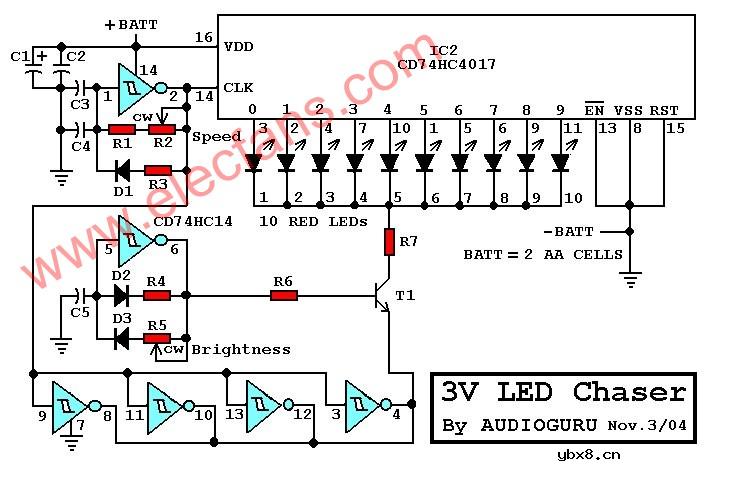
• IC2 is a 10 stage Johnson counter/decoder. On the rising edge of each clock pulse its outputs step one-at-a-time. It drives the anode of each conducting LED toward the positive supply.
• IC1a is a standard Cmos inverter Schmitt-trigger oscillator with C3 and C4 totaling 800nF for a very slow step rate. R2 is the speed control pot with R1 limiting its maximum speed. It clocks IC2 and feeds the inverters/drivers. D1 and R3 reduce its output high time to 30mS.
• IC1d, IC1e, IC1f and IC1b are paralleled inverter/drivers for a low output voltage drop and drive the emitter of T1 to ground.
• IC1c is another standard Cmos inverter Schmitt-trigger oscillator. R5 is its Pulse Width Modulation control and with D3 performs dimming of the LEDs. D2 and R4 extend the PWM’s maximum pulse width.
• T1 is a transistor that is used as a PWM switch. R7 limits maximum LED pulse current.
• C1 bypasses the battery’s supply voltage at low frequencies and C2 bypasses at high frequencies.
Construction
The ten LEDs mount on a Compact-Disc which is glued to a plastic box with contact cement. The box houses the Veroboard circuit in its lower main part with the battery holder in its lid. Multiconductor ribbon cable joins the LEDs to the circuit. The pots mount on the sides of the box.
Parts List
1 IC1 CD74HC14N or SN74HC14N High-speed Cmos, Schmitt-trigger hex inverters
1 IC2 CD74HC4017N or SN74HC4017N High-speed Cmos, decade counter-decoder
1 T1 2N3904 or 2N4401 NPN transistor
10 LEDs MV8191 High brightness wide angle red LED (less than 2V)
3 D1 to D3 1N4148 or 1N914 Silicon diode
2 R1, R3 100K 1/4W resistor
1 R2 1M Linear taper potentiometer (speed)
1 R4 330K 1/4W resistor
1 R5 1M Audio taper (logarithmic) potentiometer (brightness)
1 R6 680 1/4W resistor
1 R7 22 1/4W resistor
1 C1 100uF/10V or 100uF/16V Electrolytic capacitor
1 C2 0.1uF/50V or 0.1uF/100V Ceramic disc capacitor
1 C3 330nF/63V Metalized poly capacitor
1 C4 470nF/63V Metalized poly capacitor
1 C5 1nF/100V Metalized poly capacitor
2 misc.Alkaline battery cells 1 misc. Plastic box
1 misc.Battery holder 3 misc. Vinyl feet for box
1 misc. Compact Disc 2 misc. Knobs for potentiometers
1 misc. Hole plug for the CD’s center hole 1 misc. 9 to 11 conductor ribbon cable
Notes
1) The ICs are manufactured by Texas Instruments, and others.
2) The LEDs are manufactured by Fairchild Semiconductor.
3) Above manufacturers offer free samples.
相关热词:
 什么是感应电机?什么是无刷电机?二者有何区...
时间:2026-10-23
多核DSP的多路同步时钟信号设计
时间:2026-10-23
什么是lcd12864?lcd12864的特性及其应用举例
时间:2026-10-23
 IoT无线连接基础知识
时间:2026-10-23
光是一种电磁波,那么光的频率是多少?
时间:2026-10-22
 DRAM简介
时间:2026-10-22
电容耦合是什么意思呀?
时间:2026-10-22
什么是单总线
时间:2026-10-21
STM32的CAN总线通信实现
时间:2026-10-21
什么是电源管理?有什么作用
时间:2026-10-20
 详解RCD钳位电路
时间:2026-03-08
三相异步电动机原理
时间:2026-03-04
 美的电磁炉电路图大全(六款美的电磁炉电路...
时间:2026-03-07
三相异步电动机的拆装详讲
时间:2026-03-04
 基于逻辑门的构成解释如何完成任意逻辑的管...
时间:2026-03-08
 彩灯电路
彩灯电路
时间:2026-03-05
 光耦在电子电路中作用、关键参数详解
时间:2026-03-08
 从0学电路,万用表演示测量三极管方法
时间:2026-03-08
 NE555的有趣电路设计分享
时间:2026-03-08
 H桥电机驱动电路解析
时间:2026-03-08