
简单的LED电源项目电路 A power source for simple LED projects
LED's are great display tools. Their prices have decreased to a point where they are replacing more conventional light sources. In one sense their characteristic need for low voltages is an advantage e.g compatibility with I.C drives, but this voltage requirement can also be a disadvantage. I wanted to light some LED's in a simple sign application, nothing fancy, but I needed to decrease the utility line voltage to a LED-compatible value for this application.
The line voltage can be reduced in various ways, via dropping resistor, a transformer, a "brick" power supply, a capacitor etc. A dropping resistor wastes considerable power and generates heat. A "brick" power supply must be adapted to the particular design needs, i.e a specific voltage and current and also may have an expense associated with it that is undesirable for a simple circuit. A transformer can be bulky, weigh a lot and may be expensive.
A capacitor can act as a voltage dropping component and in this instance, was chosen to light the static LED display shown below. The considerable drop in voltage from the line (117 v.a.c) down to approximately 2-1/2 volts a.c results in an almost negligible power loss in the capacitor(s). It is simple, low cost and small.
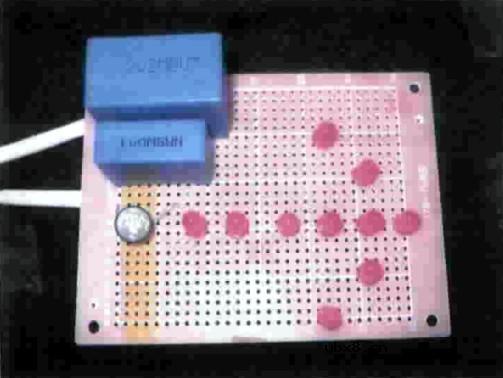
The 10 LED's were lit using the following circuit...
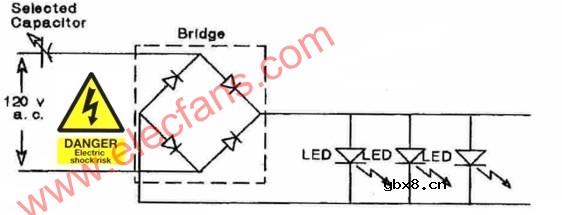
figure 2
The capacitor value may be computed via the following empirical formula. This formula is valid for the circuit shown in Fig.2:

Where "C" is in uFd and "I" is in miliamperes. A design current of 10 mA per LED was selected. Thus for ten LED's, 100mA is the total current. Inserting this current value into the formula, yields a capacitor value of 3.1uFd.
To achieve this value, two capacitors connected in parallel were used. Recall that the total capacitance of capacitors connected in parallel is simply the arithmetic sum of the individual capacitors:

Thus:

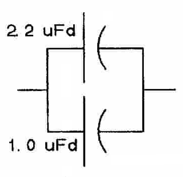
figure 3
If it becomes necessary to use capacitors connected in series to achieve a desired total capacitance, the formula for this computation is:
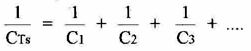
For two capacitors in series, it may be easier to calculate the total series capacitance via:
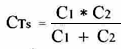
To achieve a desired total capacitance, it may be necessary to use a series-parallel connection of three capacitors. Empirical formula (1) was derived by measuring currents and voltages for various quantities of LED's (up to 30) connected into the circuit shown in Fig 2. The capacitors must be low loss, non-polarized units with voltage ratings equal to or greater than 200 volts.
Transformer voltage dropping circuit
If instead of using capacitors, it is desired to power LED's with a transformer, the low voltage, rectified sine wave ideally should be applied to each LED via a dropping resistor. This enables the forward current to be adjusted to a value that does not overdrive the LED. In lieu of using dropping resistors, if the rectified voltage is carefully selected via a judicious choice of transformer, the output of a rectifier may be applied directly to one or more LED's connected in parallel.
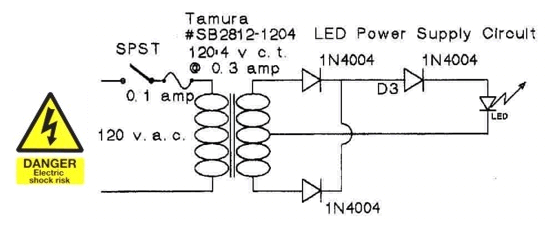
figure 4
The Tamura transformer has a 4 volts c.t secondary. This value just supplies sufficient voltage to generate 14mA for one LED. For 10 LED's or greater, omit D3.
Circuit comparison
Comparing the two approaches, the capacitor voltage dropping circuit is smaller, lighter in weight and varying the capacitor value enables the user to obtain a desired current value for each LED. The transformer approach, yields a circuit where the transformer provides isolation between the LED's and the line voltage. Both circuits are nominally low in parts cost.
Parts
The components used in gathering data where purchased from Mouser Electronics:
- 2.2 uFd = PHE840MZ7220MF14R ($2.52)
- 1.0 uFd = PHE840MY7100MD16R ($0.93) (275 Volts)
- Tamura transformer #SB2812-1204 ($3.53)
- 1N4004 diodes ($0.08 each)
The bridge rectifier and LED's were purchased from All Electronics:
- LED-1 (T1-3/4 Red LED) ($0.10 each)
- FWB-15, 1-1/2 amp, 400 PIV Bridge Rectifier ($0.50 each)
- Perf Board
Acknowledgments: My thanks to Mr. Oscar Ramsey for his testing, data gathering and construction efforts.
相关热词:#LED电源
 什么是感应电机?什么是无刷电机?二者有何区...
时间:2026-10-23
多核DSP的多路同步时钟信号设计
时间:2026-10-23
什么是lcd12864?lcd12864的特性及其应用举例
时间:2026-10-23
 IoT无线连接基础知识
时间:2026-10-23
光是一种电磁波,那么光的频率是多少?
时间:2026-10-22
 DRAM简介
时间:2026-10-22
电容耦合是什么意思呀?
时间:2026-10-22
什么是单总线
时间:2026-10-21
STM32的CAN总线通信实现
时间:2026-10-21
什么是电源管理?有什么作用
时间:2026-10-20
 详解RCD钳位电路
时间:2026-03-08
三相异步电动机原理
时间:2026-03-04
 美的电磁炉电路图大全(六款美的电磁炉电路...
时间:2026-03-07
三相异步电动机的拆装详讲
时间:2026-03-04
 基于逻辑门的构成解释如何完成任意逻辑的管...
时间:2026-03-08
 彩灯电路
彩灯电路
时间:2026-03-05
 光耦在电子电路中作用、关键参数详解
时间:2026-03-08
 从0学电路,万用表演示测量三极管方法
时间:2026-03-08
 NE555的有趣电路设计分享
时间:2026-03-08
 H桥电机驱动电路解析
时间:2026-03-08